The perfect place for a pine marten den box
Wildlife boxes create an important alternative refuge for many of Britain’s most vulnerable species. From endangered birds to bats, you can often see boxes attached to a tree to create a safe shelter for our threatened wildlife… including pine martens. Read this blog and find out how to choose the perfect site and tree for a pine marten den box.
The pine marten, once widespread across Britain, is unfortunately now one of Britain’s rarest carnivores, and one of Vincent Wildlife Trust’s (VWT) priority species for working towards its recovery.
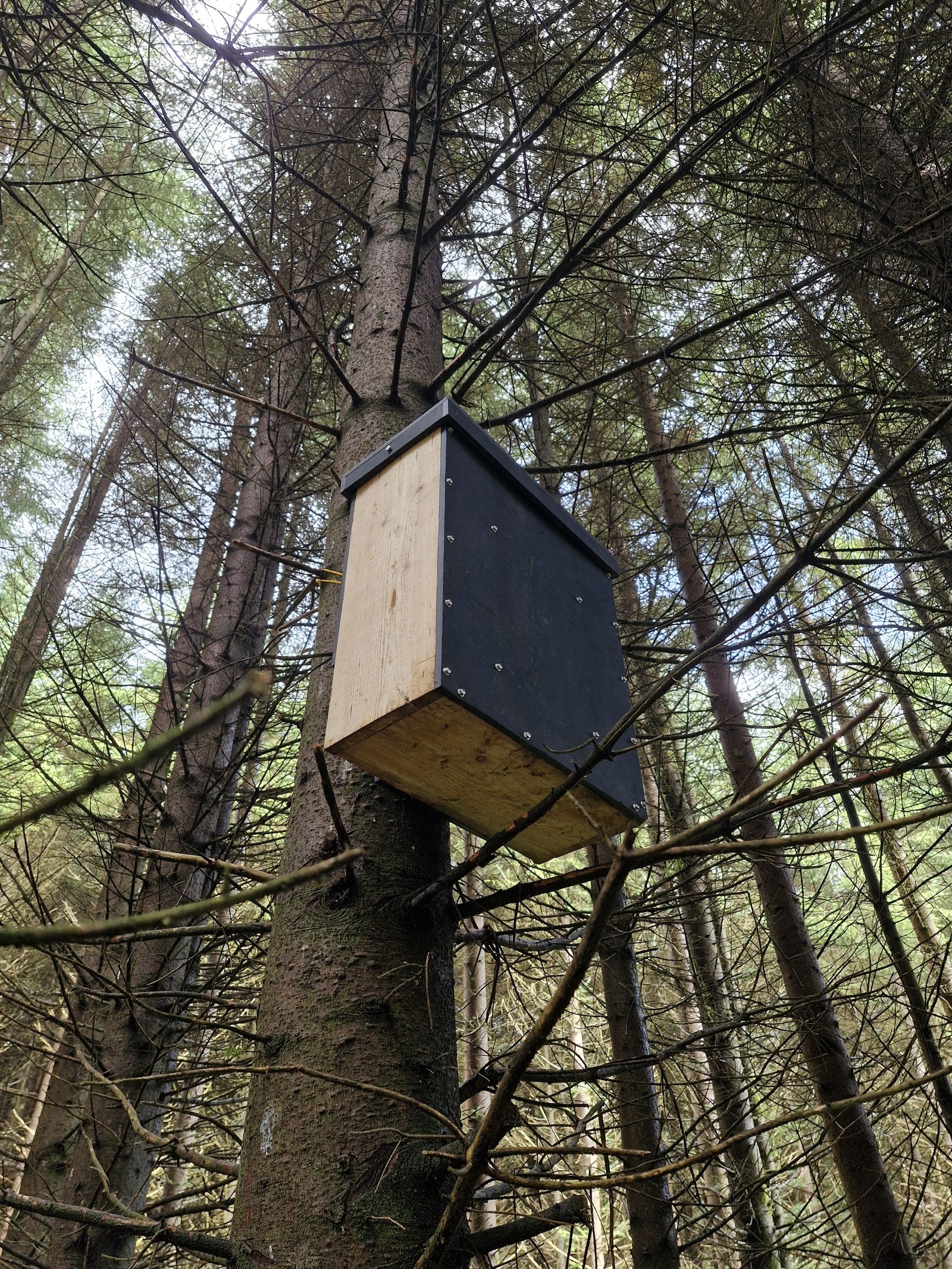
Den boxes provide a safe refuge and sheltered denning site for pine martens to rest and breed. We have been installing and monitoring den boxes for many years, and we’ve learned a thing or two!
Where do pine martens live?
Pine martens are perfectly adapted to life in woodlands, and their preferred denning sites are the large natural tree cavities that develop as trees grow very old or that are created by species such as the black woodpecker, a large bird found in mainland Europe. Unfortunately, most woodlands across Britain are relatively young in age and black woodpeckers are not found here so these natural cavities are rare or absent. While we patiently wait for the trees of Britain to age, den boxes elevated on tree trunks can replicate these important sites and provide safety from predators such as foxes.
Before you choose a tree, however, you should consider the wider landscape and habitats. Pine martens have very large home ranges, generally covering several square kilometres, that ideally consist of large, connected woodlands with adjacent rough grassland or meadows for hunting voles. Does the wider landscape have these habitats?
You can check the latest pine marten distribution map here
Finding the right location
Then consider your particular site – is it connected to other habitats that pine martens would use, such as woodlands, tree-lined river corridors and mature hedgerows with trees? Pine martens are woodland specialists, using trees to escape from predators, and so will favour habitats with trees and lots of vegetated cover, rather than wide-open spaces. Also consider if there are any wider threats, such as busy roads.

Now home in on your woodland – are there quiet, undisturbed areas within it? Are there any local disturbances to consider, such as public footpaths or cycle paths. Will future habitat management need to be carried out? Pine martens are less likely to use a den box where there is a lot of human activity and carrying out activities near a den box could also be deemed a legal offence. Consider if there are any grey squirrel control methods that could harm pine martens and need to be changed (guidance is available here). Lastly, den boxes are heavy and require equipment to install them so don’t locate it in too remote and inaccessible areas. You also need to consider if you are going to return regularly to the location for monitoring (see below).
Finding the right tree
Finally, the tree itself! We’ve listed the ideal qualities below, but every site will be different.
- The right size The tree should be large enough to easily accommodate the weight of the den box and to ensure the supports on the back of the den box will sit against the trunk. Ensure you can get your arms around the tree to attach any hauling equipment used, and to attach the den box’s fixing rope.
- Marten climbing features Certain features make it easier for pine martens to climb in and out of the den box, which are especially important for young kits practising their climbing skills. Having horizontal branches (dead or alive) immediately below and leading up to the entrances of the box is ideal, as is rough bark or ivy covering the trunk.
- Trail cameras If using a trail camera to monitor the den box, think about where you could install it — often best installed on a nearby tree but at least 5m away, which is the minimum legal distance that someone without a licence must be. So think about trail camera location and also the route to that location.
- Anyone monitoring pine marten den boxes should refer to the guide produced by NatureSpy in collaboration with VWT for information on den box monitoring in accordance with the law: Monitoring Pine Marten Den Boxes: Guidance for Effective Camera Trap Set Ups.

Finding the right place on a tree
Den boxes should be installed between 2 and 3.5 metres up the chosen tree — although 2-2.5 metres is sufficient to keep it out of reach from predators, going higher provides further protection, particularly from nosey humans on land with public access. Den boxes provide shelter from the elements, but positioning their entrances away from the prevailing wind reduces draughts getting inside the den box. Also consider how much direct sunlight the box may get – less is better to prevent potential overheating during the hotter months.

Legal protection of pine martens
If you are considering installing a den box, it is very important to know that pine martens and their den sites are legally protected under Schedule 5 of the Wildlife and Countryside Act 1981, including from disturbance. Having a den box can affect what you can and can’t do near to that den box. Pine martens don’t always leave signs at den boxes to indicate they are in use, so you should always behave assuming they are at home.
Den boxes and gardens
In parts of Britain where pine martens are more established, they sometimes visit gardens to feed on peanuts and other food. However, we wouldn’t normally advise installing a den box in a typical residential garden for a few reasons.
- Female pine martens seek out den sites to have and rear their young from late winter, when our gardens are less well used. The birth of kits in April/May coincides with the time that people start using their gardens more, which may cause a female marten to move each kit to avoid human activity, which is an incredibly risky process endangering herself and her helpless kits.
- Our gardens are used by other wildlife and domestic animals, bringing pine martens into proximity with other species, some of whom could injure or kill a pine marten.
Pine martens and domestic cats Pine martens themselves are predators, but of small mammals, and observations of interactions between pine martens and domestic cats submitted to VWT show that pine martens have come off worse of the two.
NatureSpy and VWT are working together to update the Monitoring Pine Marten Den Boxes guidance. The update will be available later in 2026.
Could you be a Martens on the Move den box host?
Martens on the Move is installing den boxes in four key locations across Britain where pine marten populations are slowly expanding. If you own or manage woodland in the Brechfa, Shropshire-Herefordshire, Solway or Tweed Valley Monitoring Hub areas and would be interested in hosting a den box, please get in touch.
Download VWT's free den box installation guide.
Katherine McBride, VWT’s Carnivore Conservation Officer